

Optimize Blow Mold Cooling: Reduce Cycle Time & Scrap in 2026
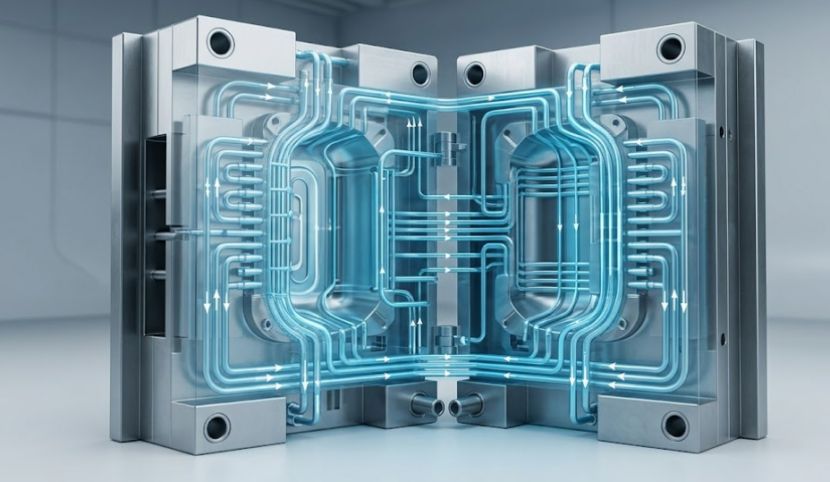
If you run a bottle line, you already know the real pain points. The cycle feels too long, bottle quality shifts from one cavity to the next, the chiller keeps working, and output still does not move the way you want. In many cases, the problem is not the machine speed. It is blow mold cooling. The cooling phase has a large effect on part quality and total cycle time in blow molding, and poor heat removal can leave you stuck with slow release, warped bottles, and rising waste.
That is why people keep asking how blow mold cooling cuts cycle time. The answer is not fancy. When heat leaves the bottle faster and more evenly, you shorten waiting time, lower the risk of shape drift, and make uniform cooling in blow molding easier to hold from shift to shift. That matters whether you make water bottles, juice bottles, edible oil containers, daily chemical packs, or pharmaceutical packaging, which are exactly the kinds of applications covered on this blowing mold page.
Why Does Blow Mold Cooling Become the Real Bottleneck?
Cooling problems rarely look dramatic at first. A line still runs. Bottles still come out. But once demand goes up or bottle weight goes down, small thermal imbalance starts showing up everywhere. It is a quiet bottleneck, then suddenly it is the only thing you can see.
Cooling Time Still Sets the Pace
In many plants, cooling time in blow molding takes the biggest share of the cycle. Research and industry guidance both point to the same thing: cooling often decides when the part can leave the mold, and that directly shapes blow molding cycle time. So if one bottle area stays hot for even a little too long, the whole mold waits. That sounds minor. Over a full shift, it is not.
The Last Hot Spot Slows the Whole Mold
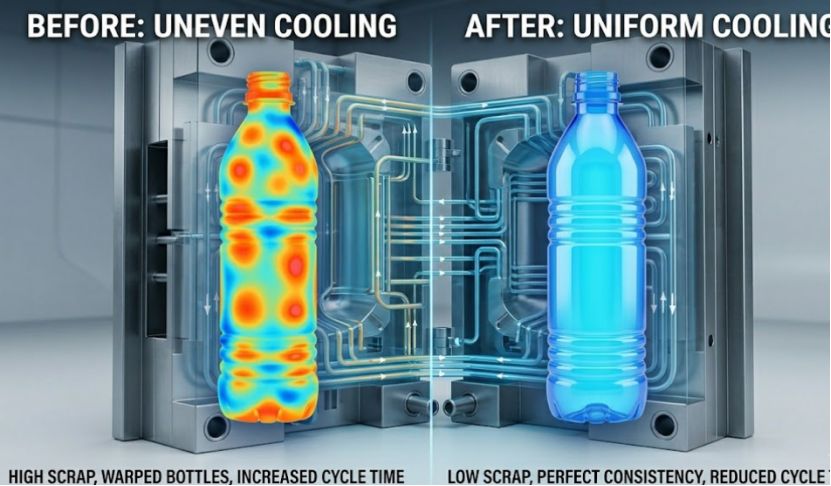
A mold does not run at the speed of its best-cooled area. It runs at the speed of the last warm spot. Often that is the base, shoulder, handle zone, or another thicker feature. When cooling is uneven, shrinkage becomes uneven too, and that leads to warp, shape drift, or visual defects. This is one reason uniform cooling in blow molding matters so much when you want stable output, not just pretty samples.
How Does Blow Mold Cooling Reduce Blow Molding Cycle Time?
If you want a shorter cycle, you do not just ask the machine to move faster. You remove heat faster, and more evenly. That is the practical side of it.
Cooling Time in Blow Molding Is Often the Longest Step
When processors try to cut blow molding cycle time, they often find the same limit: bottle release is tied to cooling, not to clamp motion or air timing. Better blow mold cooling lowers the time you spend waiting for the bottle to stiffen enough for clean demolding. That is the simplest route to more bottles per hour without pushing the line into unstable territory.
Blow Mold Design for Faster Cooling Starts With Channel Layout
Good blow mold design for faster cooling starts with sensible water paths, balanced flow, and close attention to the areas that hold heat. In plain words, blow mold cooling channel design decides whether heat leaves evenly or piles up in one stubborn zone. The knowledge base also stresses short cycle time, stable operation, and low cost as key mold outcomes, which fits this point exactly.
How Can You Reduce Scrap in Blow Molding and Cut Power Waste?
This is where customer concerns usually get very direct. You do not buy a new mold because “thermal balance” sounds nice. You buy it because you want fewer rejects, lower cost per bottle, and less wasted machine time.
Uniform Cooling in Blow Molding Improves Bottle Consistency
If you want to reduce scrap in blow molding, start with the places where bottle shape changes first. Uneven cooling shows up as wall variation, poor clarity, local sink, or a bottle that looks fine warm but drifts after release. Better thermal balance helps improve bottle consistency in blow molding, especially on lighter bottles and faster cycles. Anyone who has checked bottles right after startup and then again an hour later has seen that gap.
Energy-Efficient Blow Molding Starts With Fewer Rejects
People often talk about heaters and compressors first, but energy-efficient blow molding also depends on not wasting energy on bad parts. Every rejected bottle already used resin, heat, machine time, and cooling water. So if better cooling helps you reduce energy use in blow molding, part of that saving comes from fewer rejects and shorter running time per good bottle. That is also the simplest answer to how cooling affects blow molding energy use.
What Should You Look for in a Blow Mold Cooling System?
A better blow mold cooling system is not just about drilling channels and sending water through them. You need a mold that fits your bottle, your machine, your output target, and your maintenance reality. This is also the point where supplier choice starts to matter more than people expect.
A Bottle Blowing Mold Should Match the Whole Line
Foshan Heyan Precision Mold Technology Co., Ltd. comes across less like a simple machining shop and more like a full mold maker built around production needs. Official company information shows it combines R&D, engineering, production, and sales, with more than 15 years of production experience, a factory of over 5,000 square meters, more than 150 devices, and more than 80 corporate talents. Its scope covers preform molds, bottle blowing mold projects, cap molds, and complete supporting programs for the line. For a buyer, that matters because cooling issues rarely live alone. They usually touch bottle design, machine fit, maintenance, and after-sales support at the same time.
A High-Speed Bottle Blowing Mold Needs Serviceable Details
A high-speed bottle blowing mold also has to be practical after delivery. The knowledge base repeatedly mentions independent cooling systems, independent temperature control in related mold lines, and independent inserts that are easier to replace and maintain. It also highlights technical support, product training, lifelong maintenance guidance, and whole-line supporting solutions. Those details are not decoration. They tell you the team thinks about serviceability, not just first shipment. If your goal is how to reduce scrap in blow molding over the long run, serviceable mold details matter almost as much as the first cooling result.
If you are reviewing a new project or trying to fix an old line, start with the basics. Check where the heat really stays, ask how the cooling layout handles that zone, and ask what happens when inserts wear or water flow changes. A good mold should help you shorten cycles, hold bottle quality, and make life easier on the floor. You can compare related options through the product center, where the range includes blowing molds, multi-cavity injection molds, cap molds, and complete line support.
FAQ
Q1: What is blow mold cooling?
A: It is the heat-removal stage inside the mold, usually through water channels, that helps the bottle solidify enough for release. It has a direct effect on bottle shape, cycle time, and reject rate.
Q2: How does blow mold cooling affect blow molding cycle time?
A: Faster and more even heat removal shortens the wait before demolding. Since cooling is often the longest step, better cooling usually means a shorter blow molding cycle time.
Q3: How do you reduce scrap in blow molding?
A: Start by fixing hot spots, balancing the cooling layout, and checking whether the mold matches the bottle shape and output target. Better thermal balance helps improve bottle consistency in blow molding and lowers rejects.
Q4: How does cooling affect energy-efficient blow molding?
A: Better cooling can reduce energy use in blow molding because the line spends less time per good bottle and throws away fewer parts. That is a big part of energy-efficient blow molding.
Q5: What should you ask before buying a high-speed bottle blowing mold?
A: Ask about blow mold cooling channel design, hot-spot handling, insert replacement, machine fit, after-sales support, and whether the supplier can support the full line, not just the mold body.


