

PET Bottle Molds for Carbonated Soft Drinks: Pressure Resistance and Base Design
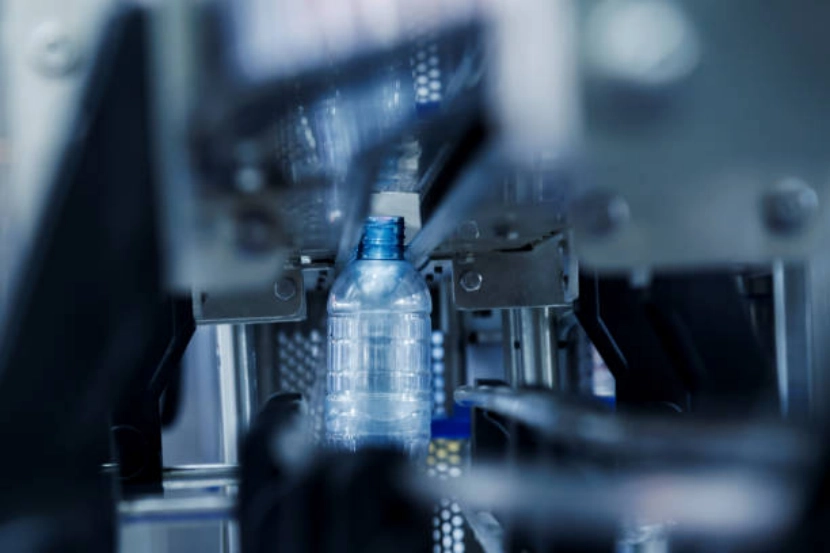
Engineering Challenges in Carbonated Soft Drink Packaging
Designing a container for carbonated soft drinks isn’t just about aesthetics; it is a high-stakes balancing act between material science and structural engineering. The internal environment of a CSD bottle is essentially a pressurized vessel that must remain stable under varying temperatures and handling conditions.
Why Pressure Resistance Dictates PET Mold Specifications
Carbonated Soft Drinks (CSD) exert significant internal pressure, often reaching up to 4-5 bar at room temperature. This internal force is relentless, searching for any microscopic thinning or structural inconsistency in the PET wall. To handle this, the blowing mold must facilitate uniform material distribution to prevent stress whitening or structural failure. If the material is too thin in one area, the bottle will deform; if it is too thick and unoriented, it becomes brittle.
Precision engineering in the blowing mold ensures the PET resin reaches its maximum biaxial orientation for optimal gas barrier properties. This orientation is what gives the bottle its “snap” and prevents the CO2 from escaping too quickly, preserving the beverage’s shelf life.
The Critical Role of Petaloid Base Geometry
The base of a CSD bottle is its most complex feature. Unlike flat-bottomed water bottles, a carbonated drink container requires a specialized “petaloid” shape to prevent the bottom from bulging outward under pressure.
Balancing Stability and Internal Stress Distribution
The five-point petaloid design is engineered to transform internal pressure into structural rigidity. By distributing the load across five “feet,” the design ensures that the pressure actually helps the bottle stand firm rather than causing it to round out. However, this geometry is difficult to manufacture. Deep valleys and sharp ribs in the base design require high-precision CNC machining in the blowing mold.
Specialized techniques are crucial here, because incorrect base geometry leads to “rockers” where the bottle loses its vertical stability under carbonation. A “rocker” is a nightmare for bottling lines, as it causes bottles to fall over during high-speed filling and labeling.
How Does Base Clearance Affect Burst Pressure?
The clearance between the gate area—the center point where the plastic was injected—and the standing surface determines the bottle’s resistance to “stress cracking.” If the gate is too close to the ground or poorly formed, the concentrated pressure will cause the plastic to fail. Advanced cooling channels within the mold base are essential to prevent thermal crystallization in the thickest part of the bottle. If the base cools too slowly, the PET stays opaque and brittle, drastically lowering the burst pressure.
Material Distribution and Wall Thickness Control
A perfect CSD bottle starts long before the blowing stage. It begins in the injection mold where the preform is created. If the preform has even a slight wall thickness deviation, that error is magnified tenfold when the bottle is blown to its full size.
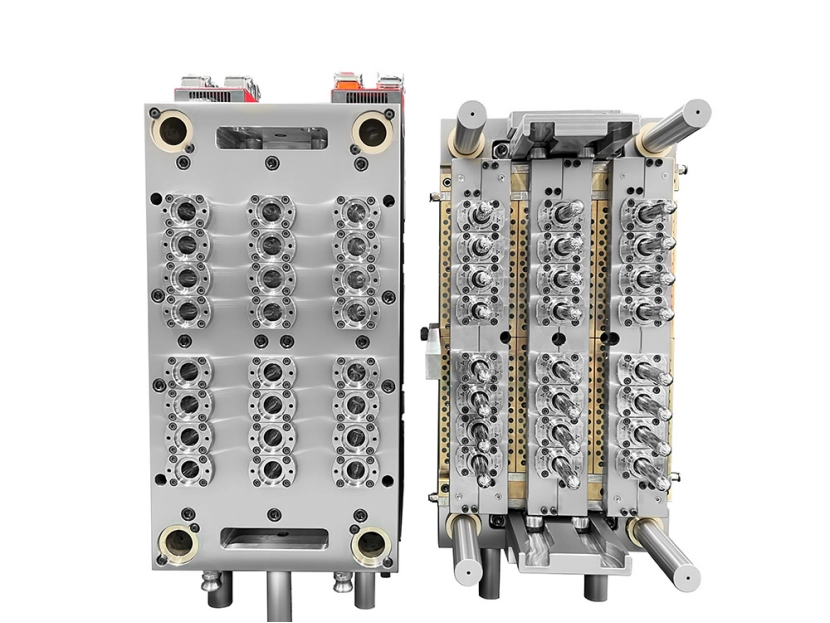
High-quality injection molds for preforms are the foundation of consistent wall thickness in the final CSD bottle. Thicker sections are strategically maintained in the neck and base, while the body is stretched to optimize resin usage. This stretching—the biaxial orientation—is where the strength comes from. Integration between the preform design and the blowing mold cavity is vital to eliminate weak spots.
Holistic Mold Integration for CSD Production
Production efficiency is often lost when different molds don’t “talk” to each other. For CSD, the cap mold, injection mold, and blowing mold must be treated as a single, integrated system.
Coordinating Preform, Blowing, and Cap Molds
The neck finish must remain perfectly circular during the high-pressure blow molding process to ensure a gas-tight seal with the cap. If the neck deforms even a fraction of a millimeter during the 40-bar blowing cycle, the cap mold’s output won’t fit correctly, leading to leaks. HEYAN TECHNOLOGY focuses on the synergy between the injection mold and the blowing mold to reduce scrap rates. The main molded parts are independent inserts, which are convenient for replacement and maintenance. Furthermore, precise venting systems in the blowing mold allow air to escape rapidly, ensuring the PET takes the exact shape of the complex base design. Without proper venting, air pockets trapped in the mold corners prevent the plastic from fully reaching the petaloid tips, compromising the bottle’s stance.
Addressing Common Defects in High-Pressure PET Containers
In the world of high-speed production, small defects become massive headaches. Stress cracking and thermal expansion are the two primary enemies of a reliable CSD container.
Preventing Stress Cracking and Deformation
Stress cracking often occurs at the gate; this is mitigated by optimized hot runner systems in the injection mold. The features of advanced and reasonable hot runner design, independent temperature control for each cavity, uniform heating temperature and independent cooling system, shorten the production cycle of products. Environmental Stress Crack Resistance (ESCR) is improved through precise temperature control during the molding cycle. If the mold is too hot, the PET doesn’t set right; too cold, and you get internal stresses.
How can mold surface treatments improve the final aesthetics and strength of CSD bottles?
Specialized polishing and coatings reduce friction during the “stretch” phase, allowing the plastic to flow smoothly into the petaloid valleys without creating micro-tears.
Managing Thermal Expansion in the Mold Cavity
CSD molds must account for the slight expansion of the PET once the bottle is pressurized. A bottle that looks perfect in the mold might expand and become out of spec once filled with carbonated liquid. Using inferior steel leads to “mold growth” over time, where the cavities actually deform under the repeated 40-bar hammering of the blowing process. High-grade stainless steel and specialized coatings extend the life of the mold against the mechanical fatigue of high-pressure cycles.
Depending on our technical advantages and practical experiences over years, combined with advanced technology, R&D capability at home and abroad, the complete set of high-quality injection mould has been produced, which has the advantages of reasonable overall structure design, high precision, stable operation, short products cycle time and low cost. Supply various types of needle valve hot runner preform mold, ranging from 1 cavity to 144 cavities.
Contact us today to discuss your CSD bottle mold project and discover a customized solution for high-performance PET packaging.
FAQ
Q: Why do CSD bottles use a petaloid base instead of a flat base?
A: A flat base would simply pop outward under the 4-5 bar internal pressure of a carbonated drink. The petaloid design uses geometry to redirect that pressure into five rigid points of contact, maintaining stability.
Q: How does the injection mold affect the final bottle’s burst pressure?
A: The injection mold determines the initial wall thickness and gate quality of the preform. Any inconsistency here leads to weak spots in the blown bottle that are prone to bursting.
Q: Can one blowing mold be used for both water and carbonated drinks?
A: Generally, no. CSD bottles require much thicker walls and a specific base design to handle pressure, whereas water bottles are designed for lightweighting and use a different base geometry.
Q: What is the benefit of using a needle valve hot runner in the injection mold?
A: Needle valves provide a cleaner gate cut, which is essential for reducing stress concentration at the base of the bottle, thereby preventing leaks and cracks.