

Two-Stage vs One-Stage PET Bottle Production: Mold Requirements Compared
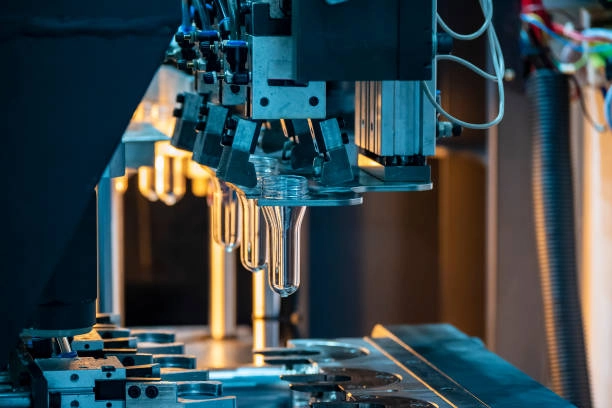
The debate between one-stage and two-stage PET bottle manufacturing isn’t just about machinery. It’s about how heat, precision, and timing define the entire production philosophy. A plant running thousands of beverage bottles per hour will think differently from a cosmetics manufacturer producing custom shapes in small batches.
What Defines One-Stage and Two-Stage PET Bottle Manufacturing?
In one-stage systems, the injection and blowing processes happen in a single continuous cycle. The preform is molded, conditioned while still hot, and blown into its final shape—all within one integrated machine. There’s no storage or reheating step. This setup favors precise control of preform temperature and geometry, critical for small scale or specialty production where uniformity matters more than speed.
Two-stage systems separate these steps. Preforms are first injection molded in large quantities, cooled, stored, and later reheated before being blown into bottles on a different line. The separation allows for mass production efficiency—ideal for beverage bottlers managing millions of identical units daily. It also means logistics come into play: preform transport, storage conditions, and reheat uniformity all affect final quality.
Why the Distinction Matters for Mold Design
The process flow dictates everything about mold design. In one-stage lines, molds must synchronize with the downstream blowing station; temperature gradients are narrow, so cooling circuits need to be fine tuned for stability rather than speed. Two-stage molds, on the other hand, prioritize dimensional stability during cooling since preforms may sit in storage before use. Cycle time optimization differs too—one-stage focuses on thermal balance across cavities, while two-stage emphasizes throughput and durability under continuous operation.
The Role of Injection Molds in Each Production Method
Injection molds sit at the heart of both systems but serve slightly different masters depending on process integration.
Injection Mold Requirements in One-Stage Systems
In one-stage setups, the injection mold directly feeds the blowing station. The geometry must be perfect because any deviation affects bottle wall distribution later on. Gate balance becomes critical—uneven flow can distort material orientation during stretch blow molding. Cooling systems operate under constant heat load; they must maintain tight temperature control without compromising cycle rhythm. Many engineers describe this as designing for “thermal choreography”—every cavity performing in sync with minimal variation.
Injection Mold Requirements in Two-Stage Systems
Two-stage injection molds face different pressures. Since preforms are stored before blowing, dimensional stability during cooling is paramount. Shrinkage or warping can ruin reheat consistency later on. Durability also takes precedence—these molds run high volume automated lines where downtime is costly. Maintenance intervals are longer but more structured; inserts and cores must withstand repetitive cycles without losing polish or alignment.
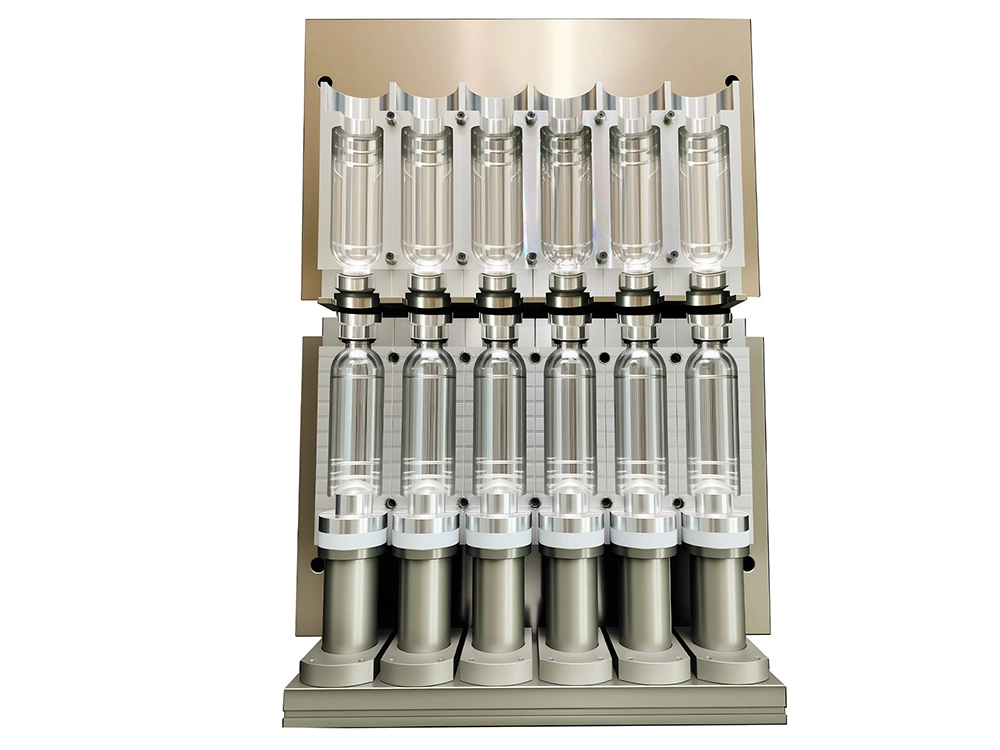
Blowing Molds: Where Production Efficiency Takes Shape
The blowing mold is where molten potential becomes tangible form—the moment plastic turns into product.
How Blowing Molds Differ Between One-Stage and Two-Stage Lines
Temperature management defines their difference. In one-stage systems, hot preforms arrive directly from injection molding; mold surfaces must align perfectly with that residual heat to avoid stress marks or uneven stretching. Precision alignment between cavities ensures consistent neck orientation—a key requirement for cosmetic or pharmaceutical bottles where aesthetics matter.
Two-stage blowing molds work differently: they receive cold preforms reheated by infrared ovens. Here the challenge lies in achieving uniform reheat profiles across multiple cavities at high speed. These molds often use advanced cooling channels to enable rapid cycling without deformation—a necessity for beverage grade efficiency.
Surface Finishing, Venting, and Cooling Considerations
Surface finish influences both appearance and function. A polished cavity enhances clarity; a textured surface diffuses light for premium branding effects. Venting design deserves equal attention—poor venting traps air during stretch blow expansion, leading to thin spots or bubbles along bottle walls. Cooling circuits snake through every contour of the mold block to extract heat evenly; any imbalance shows up immediately as inconsistent wall thickness.
Comparing Flexibility, Cost, and Maintenance Needs
Switching between product types or volumes tests how adaptable each system truly is.
Which System Offers Greater Flexibility for Product Changes?
One-stage lines excel when agility matters—custom shapes, limited runs, frequent design updates. Tool changes are quicker because everything happens within one integrated cell. Two-stage lines thrive on repetition: standard beverage bottles produced around the clock with minimal variation.
Cost Implications of Different Mold Configurations
Tooling investment diverges sharply at startup. One-stage molds tend to cost more initially due to their complexity but save space and reduce handling costs later on. Two-stage systems spread costs across multiple machines yet benefit from economies of scale once volume ramps up. Modular mold designs help both sides—swappable inserts reduce downtime during format changes without full replacement.
Maintenance Practices That Extend Mold Life
Every experienced technician knows that longevity depends less on material hardness than on discipline. Regular inspection of core pins and cavities prevents micro-scratches from turning into leaks or flash lines. Cooling channels accumulate scale over time; preventive flushing schedules keep flow rates stable and cycle times predictable. Documentation matters too—tracking wear patterns helps predict failures before they halt production.
Choosing the Right Mold Partner for Your PET Line
Selecting a supplier isn’t just procurement—it’s engineering collaboration.
What to Look for in a Professional Mold Supplier
A good partner understands both injection mold and blowing mold technologies across one and two-stage systems. They offer engineering support that fits your existing line rather than forcing adaptation around their tooling philosophy. Integration experience counts—the best suppliers anticipate mechanical interfaces, cooling requirements, even robot gripper clearances before production begins.
How HEYAN TECHNOLOGY Supports Complete PET Solutions
HEYAN TECHNOLOGY provides expertise in bottle preform molds, blowing molds, cap molds, and full line PET systems. Their engineering team customizes each solution based on product specifications and output goals. They emphasize precision manufacturing that enhances efficiency across both one-stage and two-stage operations. That combination of technical depth and practical flexibility makes them a reliable choice when scaling production or upgrading legacy equipment.
FAQ
Q1: Which system is better for lightweight bottle designs?
Two-stage systems generally perform better due to optimized reheat control allowing thinner wall sections without compromising strength.
Q2: How often should an injection mold be serviced?
Routine cleaning every few thousand cycles is typical; full preventive maintenance depends on resin type and operating temperature history.
Q3: Can one supplier handle both injection and blowing molds effectively?
Yes—companies like HEYAN TECHNOLOGY specialize in complete PET solutions covering both stages seamlessly.
Q4: What causes uneven bottle wall thickness?
Usually poor venting design or inconsistent preform heating during blow molding leads to uneven material distribution across the bottle body.