

Why Your Blow Molding Fails? It Starts with Injection Molding Defects

In the fast world of plastic packaging, a production manager’s worst nightmare is a high scrap rate at the blow molding station. When bottles burst, leak, or look cloudy, the immediate reaction is often to blame the blow molding machine. Technicians spend hours adjusting heat profiles and stretch rod speeds, hoping to fix the issue.
However, in many cases, they are trying to solve the wrong problem. The old saying “Garbage in, garbage out” applies perfectly here. If the PET preform quality control is weak at the source, even the best blow molding machine cannot produce a good bottle.
Reliable manufacturers like HEYAN Technology understand that the physical properties of the bottle are locked in during the injection stage. To fix blowing problems, one must look upstream at the injection molding defects that are silently killing production efficiency.
1. Case 1: Uneven Wall Thickness & Bursting
The most common failure in the blow molding process is the “leaner.” This is a bottle that stands crooked or has one side that is paper-thin while the other side is thick. During the high-pressure blowing phase, the thin side often bursts, causing machine downtime.
The Injection Culprit: Preform Eccentricity
While operators might try to adjust heating lamps to compensate, the root cause is often PET preform defects known as eccentricity. This happens when the mold core and cavity are not perfectly aligned.
If the injection mold base is not rigid enough, the high pressure of injection causes the steel plates to flex. This micro-movement shifts the core slightly off-center. The result is a preform that looks straight to the naked eye but has uneven walls.
To prevent this, high-volume lines require a rigid multi-cavity injection mold that uses a self-locking structure. This ensures that the core stays perfectly centered, eliminating the root causes of uneven wall thickness in PET bottles.
2. Case 2: Haze, Opacity & Brittleness
A high-quality PET bottle should be crystal clear. Sometimes, however, bottles come out of the mold looking milky, hazy, or with white pearlescent bands. These bottles are not just ugly; they are brittle and fail drop tests.
The Injection Culprit: Uncontrolled Crystallinity
This is rarely a blowing issue. It is a cooling failure. PET needs to be cooled down fast to remain clear (amorphous). If the injection mold’s cooling system is inefficient, heat stays in the plastic too long, allowing crystals to form.
Identifying crystallinity in PET preforms is critical. If the preform is slightly opaque coming out of the injection mold, re-heating it in the blow molder will only make the problem worse. The solution lies in optimized water channel design within the injection mold to ensure rapid, uniform heat removal.
3. Case 3: Leaking Necks & Bottom Stress
Sometimes the bottle body looks fine, but the cap leaks. Or, the bottom of the bottle has a sharp piece of plastic that scratches the blow mold or causes stress cracks (bottom burst).
The Injection Culprit: Flash and Gate Vestige
These are classic injection molding defects blow molding lines suffer from.
-
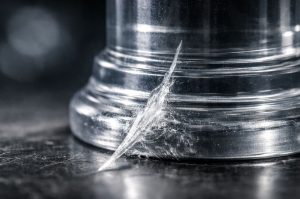
Flash: If the mold steel is soft or the clamp force is weak, plastic seeps out at the parting line. This creates a “fin” on the neck finish, preventing the cap from sealing tightly.
-
Gate Vestige: If the hot runner valve gate does not close cleanly, it leaves a long tail or a sharp nub on the preform bottom. During blowing, this hard nub prevents the stretch rod from centering the material correctly, leading to off-center bottoms.
4. Troubleshooting: Is it the Mold or the Machine?
When defects arise, the blame game begins. Is it the preform (injection) or the bottle maker (blow)? Here is a simple way to check.
The Cavity ID Check: Look at the bottom of the defective bottles. Read the mold cavity number.
-
Scenario A: If the defect always appears on bottles from Cavity #12 and #48, the issue is the injection mold. You have specific PET preform defects in those cavities (likely blocked cooling or worn cores).
-
Scenario B: If the defect appears randomly across all cavity numbers, the issue is likely the blow molding machine (unstable heating) or the raw material (wet resin).
This method is the first step in troubleshooting PET blow molding problems effectively.
Conclusion: Quality Starts at the Source
Trying to fix injection errors during the blow molding stage is a waste of energy. It costs money and time. The most effective strategy is to ensure the preform is perfect before it ever reaches the blow molder.
Factory owners should review the full range of solutions in the product center to understand how precision engineering can eliminate these upstream risks. By investing in a mold that guarantees concentricity and efficient cooling, you solve the blowing problems before they happen.
The Engineering Advantage
For manufacturers tired of chasing defects, HEYAN provides a stable foundation. The company focuses on eliminating the variables that cause downstream failures.
By using genuine S136 steel to prevent flash and employing self-locking structures to stop eccentricity, HEYAN molds deliver preforms that run smoothly on any brand of blow molding machine. This “prevention first” approach ensures that the production line runs faster and with less waste.
FAQ: Common Questions on Preform Quality
Q1: Can I fix preform eccentricity by adjusting the blow molder heat?
A: You can try, but it is not a fix. You can differentially heat the preform (make the thick side hotter) to try and even out the wall distribution. However, this is a band-aid solution. The process window becomes very narrow, and scrap rates will remain high. The only real fix is repairing or replacing the injection mold.
Q2: What is the main cause of black specks in PET preforms?
A: Black specks are usually degraded material. This often happens inside the hot runner system if there are “dead spots” where plastic sits and burns over time. It can also come from a dirty barrel screw in the injection machine.
Q3: How do I know if my preform has high crystallinity?
A: Visual inspection is the easiest way. A good preform is clear like glass. If you see a milky white haze, especially near the gate (bottom) or the thickest part of the neck, that is crystallinity. It means the mold cooling is too slow or the water temperature is too high.
Q4: Why does the gate vestige length matter?
A: The gate vestige (the nub at the bottom) must be short, typically under 0.3mm. If it is too long, it hits the blow mold base cup before the bottle is fully formed. This cools the plastic too early and can cause the bottle bottom to crack or look white.
Q5: What is the most important QC tool for preforms?
A: A polarizing light box is essential. By looking at the preform under polarized light, you can see the internal stress patterns. This helps identify PET preform quality control issues like uneven cooling or flow lines that are invisible to the naked eye.
Struggling with high reject rates in your blow molding line? The problem might be your mold, not your machine. Please contact the team for a technical audit of your preform production process.


