

How to Reduce Cycle Time in PET Preform Injection Molding
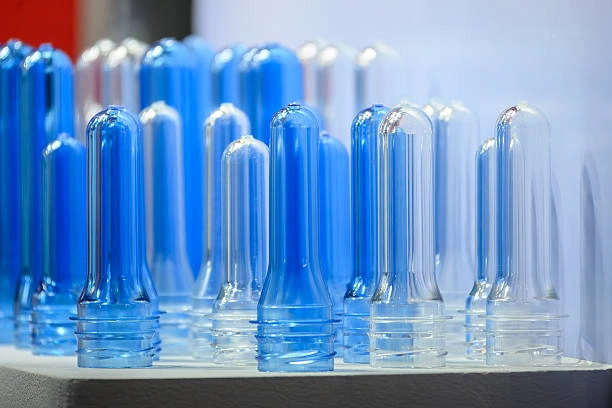
In PET preform production, a few seconds can be expensive.
A 48-cavity or 72-cavity mold running continuously makes the effect of cycle time very visible. Cutting one second from a stable cycle may add thousands of preforms to daily output. But there is an obvious limit.
Reducing PET preform injection molding cycle time is therefore not about making every machine movement faster. The useful gains normally come from the mold, cooling circuit, hot runner, machine capacity and processing conditions working together.
What Determines PET Preform Injection Molding Cycle Time?
A PET preform molding cycle includes injection, filling, holding, cooling, mold opening, ejection and mold closing.
Not every stage deserves equal attention.
On many PET preform molds, cooling takes a significant share of the total cycle. That makes it an obvious place to look, but not the only one. A slow plasticizing system, unstable hot runner or unnecessarily long holding stage can easily cancel out improvements made elsewhere.
1. Optimize the PET Preform Mold Cooling System
Cooling performance is often where the real cycle-time difference between two PET preform molds appears.
A mold can look excellent on a drawing and still run slowly if heat cannot leave the core and cavity efficiently. This becomes more noticeable with thick preform sections, heavier preforms and high-cavity molds.
Improve Cooling Channel Design
Cooling channels should remove heat quickly and, just as importantly, evenly.
Poor circulation around the core can leave local hot areas even when the average cooling-water temperature looks acceptable. Operators then extend cooling time until the hottest preforms can be ejected safely. The entire mold waits because of a few weak thermal zones.
Good PET preform mold cooling design keeps water passages close enough to critical areas while maintaining practical strength and flow.
Uniformity matters. A very fast cooling circuit is not especially useful if one group of cavities consistently runs hotter than the rest.
Maintain Stable Cooling Water Conditions
Even a well-designed PET preform mold cooling system loses performance when water conditions deteriorate.
Flow rate should be checked, not assumed. Cooling channels can gradually develop scale or contamination, particularly in plants where water treatment is inconsistent. The change is slow. A mold that originally ran a stable 12-second cycle may eventually need more cooling time, and the reason is sometimes blamed on resin or machine settings.
Temperature stability also matters. Large fluctuations in inlet water temperature make it difficult to maintain a narrow processing window.
Cleaning the cooling circuit is not sophisticated work, but it can recover cycle time that operators thought was permanently lost.
2. Use an Efficient Hot Runner System
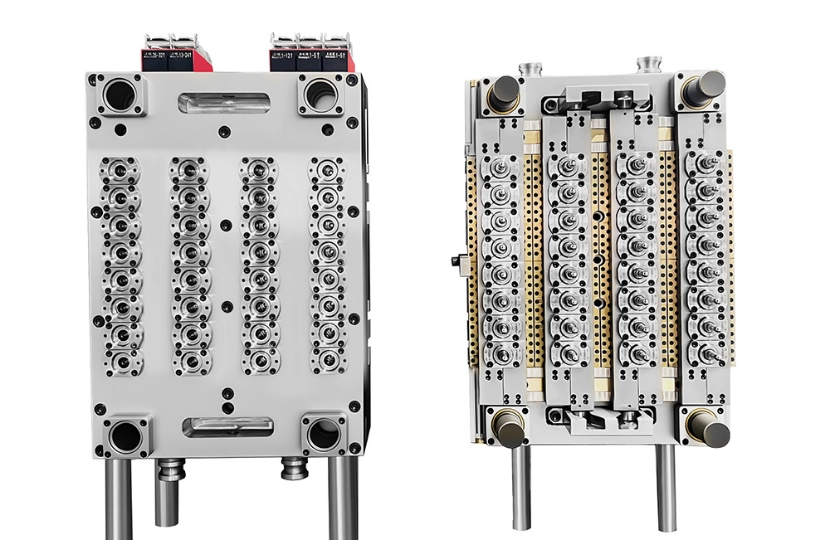
In a multi-cavity PET preform mold, the hot runner has to deliver melt to every cavity under very similar conditions.
Poor balance creates trouble quickly. Some cavities fill early, others late. Pressure differences increase. Operators compensate with more injection pressure, longer holding or a wider processing window.
That is not an efficient way to run a high-output mold.
A stable PET preform hot runner system should maintain consistent melt temperature and balanced flow across cavities. Valve gate movement also needs to remain repeatable. Worn valve pins, heater problems or temperature variation may not stop production, but they often make a short cycle much harder to maintain.
A few tenths of a second saved on paper means little if cavity-to-cavity consistency becomes worse.
3. Optimize Injection and Holding Parameters
Machine settings should support the mold rather than fight it.
Injection speed, melt temperature, injection pressure, holding pressure and holding time all influence the available cycle window. There is usually some room to shorten the process, especially when settings have been copied from an older mold or established very conservatively during initial production.
Holding time deserves close attention. Once the gate is effectively frozen, additional holding provides little benefit and simply occupies machine time.
The same caution applies to melt temperature. Raising temperature may improve flow, but the extra heat has to be removed again during cooling.
A useful target is the shortest stable cycle. Not the shortest cycle that can produce ten acceptable shots during a trial.
If preform weight, dimensions or gate appearance begin drifting after several hours, the process was probably pushed too far.
4. Match the Preform Mold with the Right Injection Molding Machine
A good mold cannot compensate indefinitely for an undersized machine.
Clamping force, injection capacity, plasticizing capacity, injection pressure and mold dimensions all need to match the PET preform mold and required output.
This becomes particularly important when cavity count increases.
A 96-cavity mold may offer attractive theoretical output, but if the injection molding machine cannot plasticize the required PET volume comfortably within the available cycle, recovery time becomes the bottleneck. The mold waits for the machine.
Machine selection should therefore be based on the preform weight, cavity number, resin characteristics and target cycle rather than cavity number alone.
For new projects, mold-machine matching should be considered before the equipment is ordered. Correcting a mismatch after installation is much more expensive.
5. Select the Right Number of Mold Cavities
More cavities increase output per shot, but they do not automatically create the most efficient production system.
PET preform molds may use 24, 48, 72, 96, 128 or even 144 cavities depending on the application and equipment. As cavity count rises, cooling balance, hot runner performance, injection capacity and process control become more demanding.
A factory producing several preform specifications may sometimes gain more practical flexibility from a moderate cavity configuration. A dedicated high-volume water preform line has different priorities.
The better number to compare is preforms per hour, not cycle time by itself.
A slightly longer cycle on a properly matched high-cavity system may produce far more output than an aggressively tuned smaller mold.
How HEYAN TECHNOLOGY Helps Improve PET Preform Production Efficiency
HEYAN TECHNOLOGY supplies PET preform molds and injection molding system solutions based on actual production requirements rather than a standard mold configuration.
Preform weight, neck finish, cavity number, injection molding machine specifications and required hourly output all affect mold design and system selection.
For high-volume projects, attention is given to multi-cavity mold configuration, cooling efficiency, hot runner performance and mold-machine matching. HEYAN can also support injection molding system integration when a customer is planning a new PET preform production line rather than replacing a mold alone.
This approach matters because cycle time is usually a system issue.
Changing the mold without checking the machine may leave the original bottleneck untouched. Buying a larger machine without improving cooling can do exactly the same thing.
Conclusion — Improve Output by Optimizing the Entire Molding System
Reducing PET preform injection molding cycle time usually comes from several small improvements working together.
Cooling may need attention. Holding time may be longer than necessary. The hot runner may need maintenance. The machine may simply be too close to its plasticizing limit.
The useful question is not, “How fast can this mold run?”
It is, “How fast can this PET preform molding system run continuously while maintaining acceptable preform quality?”
For a new PET preform production project or an existing line that needs higher output, HEYAN TECHNOLOGY can provide PET preform mold and injection molding system solutions according to preform specifications, machine conditions and target production capacity.
FAQ
Q: What is a good cycle time for PET preform injection molding?
There is no single correct cycle time. Preform weight, wall thickness, neck design, cavity number, mold cooling performance and injection molding machine capacity all affect the result. Comparing two molds only by advertised cycle time can therefore be misleading.
Q: Can cooling time be reduced by using colder water?
Sometimes, but colder is not automatically better. Very low cooling-water temperatures can create condensation and may introduce other production problems. Stable flow, efficient cooling-channel design and balanced heat removal are usually more important than simply lowering the water temperature.
Q: Does a higher-cavity PET preform mold always improve production efficiency?
Not necessarily. Higher cavity counts increase output per cycle, but they also require sufficient injection capacity, plasticizing performance, cooling capacity and hot runner stability. A properly matched 72-cavity system can be more productive in practice than a poorly matched 96-cavity system.
Q: How can an existing PET preform line achieve a shorter cycle?
Check the cooling circuit, actual water flow, holding time, screw recovery time, hot runner condition, valve gate operation and mold movements. In older production lines, several small delays often exist at the same time. Removing those delays is usually safer than making one aggressive process change.
Q: When should a PET preform mold be upgraded or replaced?
An upgrade becomes worth evaluating when cooling performance remains poor after maintenance, cavity consistency becomes difficult to control, spare-part problems increase or the existing mold no longer matches the required production capacity. Machine compatibility should be checked before deciding between mold modification and full replacement.