

PET Bottle Base Deformation: Blow Mold Causes and Solutions
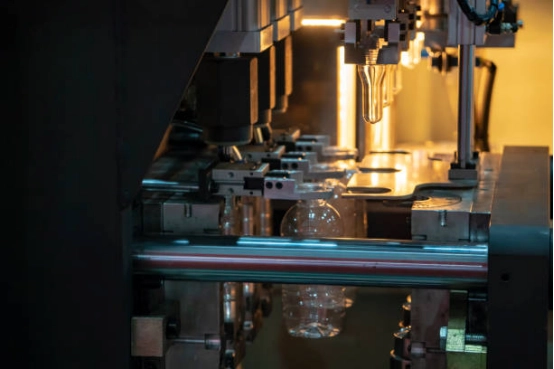
PET bottle base deformation is rarely cosmetic. A bottle that rocks, shows uneven petaloid feet, or develops a bulged center can create trouble during filling or packing.
When the defect repeats in the same cavity, inspect the PET bottle blow mold before chasing heater settings or blow pressure. Geometry, alignment, cooling, wear, and machine compatibility all matter.
What Does PET Bottle Base Deformation Look Like?
The base usually gives useful clues. Watch how the defect repeats: same cavity, same foot, same direction, or the same change after cooling.
Rocking or Unstable Bottle Base
A rocking bottle often has one foot slightly higher than the others or an uneven contact ring. It may look minor on a table and become obvious on a high speed conveyor.
One line produced bottles that stood normally when warm but rocked after cooling. A small height difference in one base insert was the cause.
Bulged or Collapsed Base
A base center that pushes outward may indicate weak support geometry or insufficient local cooling. A collapsed center can appear immediately after mold opening or several minutes later.
If the bottle leaves the mold looking acceptable and changes shape during cooling, mold temperature and cooling balance deserve an early check.
Uneven Petaloid Feet or Off Center Base
Different foot heights, an off center gate, or asymmetric material distribution often point toward alignment or base geometry.
Petaloid bases are sensitive. A small mismatch can become obvious on a carbonated bottle under pressure.
How Can You Tell If the Blow Mold Is Causing the Deformation?
Mark bottles by cavity and place several samples on a flat reference surface. Check them immediately after blowing, then again after cooling.
If one cavity keeps producing the same deformation, inspect the mold before changing the recipe. Check base insert concentricity, cooling flow, surface condition, venting, and locating components.
If every cavity shows a similar defect, check preform heating, stretch position, blow timing, material distribution, or filling conditions.
Changing machine parameters for one bad cavity can create problems in good cavities.
5 Blow Mold Causes of PET Bottle Base Deformation
Most mold related base defects come back to a short list.
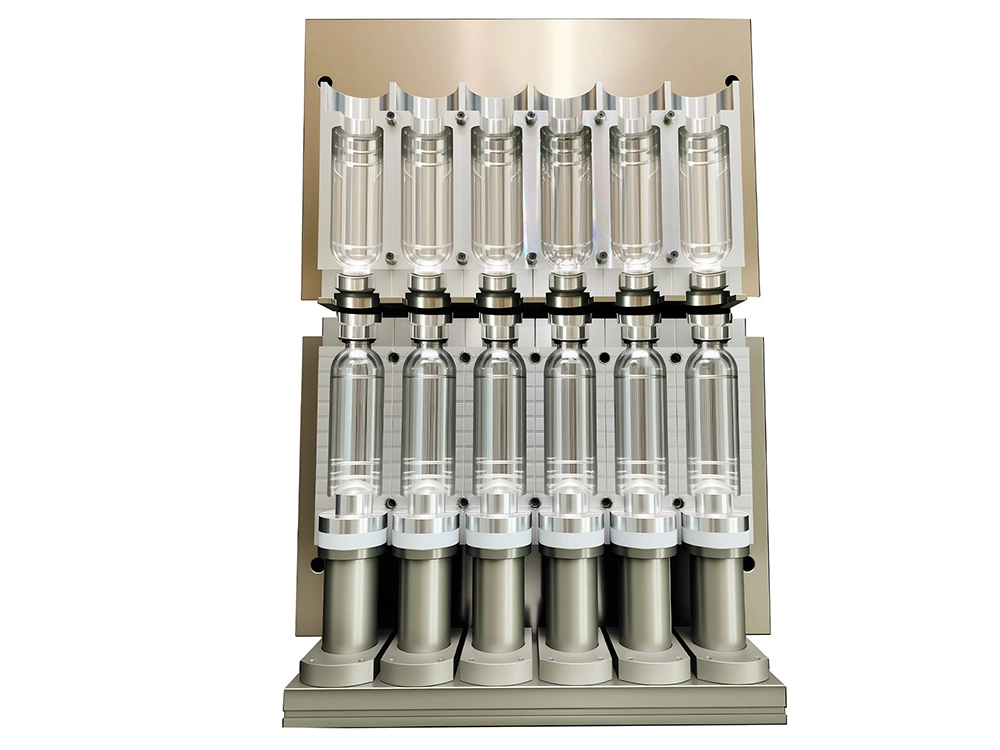
1. Incorrect Bottle Base Mold Geometry
Base geometry controls floor contact, material distribution, and how pressure is carried through the feet and center.
Contact ring dimensions, foot profile, transition radius, base depth, and support area all matter. A design that performs well for still water may not behave the same way for CSD, hot fill, or lightweight bottles.
A small change to the insert radius or foot support area may be enough. If the bottle repeatedly fails stability or pressure testing, compare the drawing with the machined profile.
2. Base Mold Misalignment
Misalignment can create an off center gate, uneven feet, or one sided thickness around the bottom.
Check the cavity, base insert, neck support, and stretch rod axis. Worn guides or locating parts can shift the base after installation. This is a mechanical problem. Heater adjustments may hide it for a while, but they do not remove it.
3. Uneven or Insufficient Mold Cooling
Cooling problems are common and easy to underestimate.
A blocked channel, scale buildup, poor water distribution, or a badly positioned passage can leave one area hotter. The bottle may look correct at ejection, then shrink unevenly.
Measure actual flow rather than judging by hose temperature. Compare inlet and outlet temperatures between cavities. Cooling water capacity should also be checked as part of the complete PET bottle blowing system, especially when several cavities begin showing the same temperature drift.
On older molds, cleaning a restricted passage can remove a deformation that operators were masking with longer cycle time.
4. Worn or Damaged Base Mold Surfaces
Base inserts wear under repeated thermal and mechanical load. Rounded edges, deposits, and damaged vents can affect forming or heat transfer.
Inspect the contact ring, foot edges, vent grooves, and high wear areas. A clear wear band may appear when compared with a new insert.
Minor damage can often be repaired or remachined. Severe wear usually justifies replacement.
5. Poor Mold to Machine Compatibility
A blow mold is not only a bottle shape. It has to work with the actual machine.
Mounting accuracy, cooling connections, stretch rod position, base movement, and machine specific dimensions affect repeatability. A mold transferred between machines without checking them can become unstable.
At higher speeds, small alignment errors that survive a slow trial may become unstable during continuous production.
Why Process Adjustments Cannot Always Fix a Mold Problem
Operators naturally try process settings because they are quick to change. Cooling time is increased. Lower heater zones are reduced. Pre-blow timing moves. Blow pressure goes up.
Sometimes that helps. Sometimes it only narrows the production window.
Process parameters can compensate for small variation, but they cannot permanently correct wrong base geometry, severe wear, mechanical misalignment, or a blocked cooling channel. If the same cavity keeps showing the same defect after recipe changes, inspect that cavity.
A Practical PET Blow Mold Troubleshooting Sequence
A useful troubleshooting sequence is straightforward:
-
Mark defective bottles by cavity.
-
Confirm the deformation pattern.
-
Check bottles after blowing and again after cooling.
-
Inspect the contact ring and base profile.
-
Verify base insert and cavity alignment.
-
Measure cooling water flow and temperature.
-
Inspect vents, inserts, guides, and worn surfaces.
-
Compare the defective cavity with a stable cavity.
-
Change one variable at a time.
-
Decide whether adjustment, repair, remachining, or replacement is required.
Too many troubleshooting sessions become a series of simultaneous changes. Then the actual cause is difficult to prove.
When Should the PET Bottle Base Mold Be Modified or Replaced?
Modification makes sense when the mold is mechanically sound but the base design no longer fits the application. Lightweighting is a common case. A base that worked at a heavier bottle weight may become unstable after material reduction.
Replacement is more reasonable when cooling performance cannot be restored, inserts are heavily worn, locating accuracy is poor, or repeated repairs no longer hold tolerance.
A cavity that keeps producing the same defect after cleaning, alignment, and controlled process checks is usually telling the truth.
Improve Bottle Base Stability with the Right Blow Mold
Stable PET bottle bases depend on geometry, cooling balance, alignment, and machine matching.
HEYAN TECHNOLOGY supplies customized PET bottle blow molds for different bottle applications and machine configurations, together with complete blow molding system solutions. For evaluation, useful information includes the bottle drawing, preform specification, machine model, cavity number, and defect samples or photos.
Specific defect data makes it easier to separate a mold side cause from a process issue. Send us your bottle drawing, preform specification, blowing machine model and defective bottle samples for mold evaluation.
FAQs
Q: Why does my PET bottle rock after blow molding?
Uneven foot height, an irregular contact ring, base insert misalignment, or uneven cooling are common causes. Check whether the rocking follows one cavity. If it does, inspect that mold position before changing the full machine recipe.
Q: Why is only one blow mold cavity producing deformed bottle bases?
A single cavity defect usually points toward a local issue such as restricted cooling flow, insert misalignment, worn surfaces, damaged locating parts, or a geometry difference. Compare that cavity directly with a stable one.
Q: Can changing blow pressure fix PET bottle base deformation?
It can help when the defect is related to material distribution or incomplete forming. It will not correct a worn insert, blocked cooling passage, wrong base geometry, or mechanical misalignment. If higher pressure only improves the defect slightly, the mold still needs inspection.

